Japanese Agricultural Cooperative Experience and Prospects for Chinese Agricultural Organizations
China’s land distribution shares many similarities with Japan, the most important being limited land and large population, with small and dispersed agricultural production scales. This leads to difficulties in circulation between the vast market demand for agricultural products and the small, scattered supply.
Addressing this characteristic, Japan developed a unique agricultural product circulation system during its post-war period, which effectively achieved stable farmer income and market supply. Therefore, in the context of China’s vigorous development of rural agricultural organizations at that time, it held significant reference value.
Japanese Agricultural Cooperative Experience
Japan’s agricultural product quality, pricing, and degree of fine processing have reached relatively high levels, and its agricultural production modernization process is also at the forefront globally. The reason is that Japan established the world-renowned comprehensive farmer cooperative organization—Japan Agricultural Cooperative Association (JA). It represents the interests of dispersed small farmers in negotiations with the government and large industries, ensuring farmers’ interests are protected, and becoming the most important driving force for Japanese agricultural modernization and government implementation of rural development policies.
The Japanese Agricultural Cooperative (JA) is a comprehensive agricultural cooperative organization whose members include 99% of Japanese farmers and numerous agricultural product circulation-related industry personnel. It has established an extensive network in Japan, providing comprehensive services and guarantees for farmers in production, sales, credit, insurance, education, healthcare, rural public facilities, and agricultural production technical guidance. Its organizational structure is shown in Figure 1.
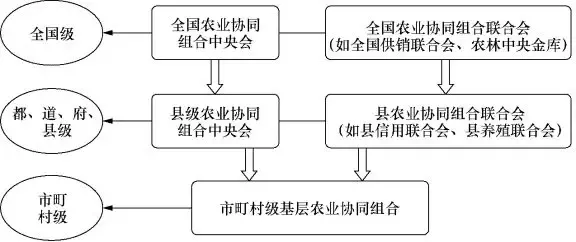
Figure 1
Regarding its nature, the Japanese Agricultural Cooperative can be said to have dual characteristics of both enterprise and non-governmental organization:
First, the cooperative’s management and operations are conducted according to enterprise business laws and regulations.
Second, the cooperative is also a farmers’ cooperative, representing farmers’ interests and becoming an important lobbying group in Japanese politics. Simultaneously, the cooperative intervenes in farmers’ production and living spheres, providing guidance to farmers from multiple aspects, with its purpose being to serve farmers rather than generate profits.

The Japanese Agricultural Cooperative’s business operations are divided into the following aspects:
◆ Guidance Services: Providing information services and guidance to farmers in agricultural education, agricultural management, and even rural life.
◆ Economic Services: Including purchasing and sales operations, i.e., unified purchasing of daily production materials and unified sales of agricultural products, as well as establishment of rural public facilities.
◆ Credit Services: Providing financial credit services to farmers through the cooperative credit union and Norinchukin Bank (hereinafter referred to as Norinchukin).
◆ Mutual Aid Services: Agricultural insurance operations, providing insurance services to farmers against natural disasters and other risks.
◆ Welfare Services: Healthcare services carried out to ensure members’ health.
◆ Utilization Services: Public facility services, jointly purchasing and constructing equipment and facilities difficult for individual members to purchase or construct for cooperative members’ shared use, with members only needing to pay usage fees.
◆ Other Services: Including processing services, tourism services, agricultural management entrusted business services, agency services for agricultural land sales, leveling residential land, construction and management of rental housing services.
We can see that such a national organization basically covers all needs of Japanese agriculture and agricultural population, greatly reducing the burden on the agricultural population and increasing their welfare. However, over time, the Japanese Agricultural Cooperative has maintained a semi-official, semi-private monopoly position, with organizational corruption and declining efficiency continuously emerging. Therefore, in 2015, the Japanese government determined to propose the framework for the “Agricultural Cooperative Association Law” amendment at the regular Diet session. The guidance and supervision authority of the Japan Agricultural Cooperatives Central Union (JA Zenchu), which oversees national agricultural cooperative organizations, will be completely abolished within three years, converting it into a voluntary organization. By abolishing the mandatory binding force of JA Zenchu within the JA group, regional agricultural cooperatives and farmers are promoted to freely compete in crop prices, services, and circulation channels.
Prospects for Chinese Agricultural Organizations:
From the Japanese Agricultural Cooperative experience, appropriately scaled agricultural associations have the following benefits:
(一) Appropriately Comprehensive Agricultural Cooperatives Can Become Helpers for National Agricultural Policy Implementation
In the early stages of agricultural development, the Japanese Agricultural Cooperative significantly improved farmers’ operational efficiency, solved considerable practical problems for farmers, while being able to actively cooperate with national policies, thus rapidly and effectively developing Japanese agriculture.
(二) Appropriate Cooperative Scale Can Balance Competitive Efficiency and Economies of Scale
In the later stages of Japanese Agricultural Cooperative development, due to its large organization and semi-official monopoly position, inevitably many problems arose, such as using monopoly position to extract substantial benefits from farmers and other citizens, while also generating much corruption. Appropriate cooperative scale can avoid these issues. As a country with vast territory and population, China cannot reference Japan to organize such a large agricultural cooperative. Agricultural associations organized at the county/city level can both avoid monopoly-induced corruption and also achieve economies of scale development.
(三) Appropriate Agricultural Scale Can Establish Rural Financial Cooperative Organizations
China’s agricultural producers have long faced capital shortage issues, especially during the current land transfer period, where land cultivators often need substantial funds for investment, while land is often contracted. Once natural disasters occur, it often causes cultivators to lose everything. For most financial institutions, agricultural finance not only presents large risks and difficult collection issues but also faces national regulation of profits, making returns often too low. Therefore, appropriately scaled agricultural cooperation can independently or cooperatively develop agricultural finance, helping agricultural producers obtain financial assistance.
In summary, the author believes China can reference the functions and development course of the Japanese Agricultural Cooperative to develop local agricultural associations with Chinese characteristics, serving as a supplement between the government and commercial companies, accelerating the development of China’s new-era agriculture.